

Introdução
Nesta lição, você aprenderá a dividir números de vários dígitos que tenham um número inteiro positivo ou número natural ou um decimal como resposta. Infelizmente, as respostas para problemas de divisão nem sempre são números inteiros positivos ou números naturais.
Pessoas ao redor do mundo usam algoritmos ou métodos de divisão diferentes. Esta lição ensinará um método. Sinta-se à vontade para usar o método que funciona melhor para você.
Esses vídeos ilustram o material da lição abaixo. Assistir aos vídeos é opcional.
- Divisão por um Número Inteiro Positivo ou Natural | Transcrição
- Algoritmo da Divisão (Respostas com Decimais) | Transcrição
- Dízimas Periódicas | Transcrição
Divisão por um Único Número Inteiro Positivo ou Número Natural
Você aprenderá a fazer divisão com vários dígitos. Este processo é aplicável para números que podem ser divididos uniformemente e números com respostas decimais. Se você estiver familiarizado(a) com outro algoritmo ou padrão, sinta-se à vontade para usá-lo. O importante é entender o que você está fazendo e o motivo, para poder aplicar isso a situações do mundo real.
Passos da divisão:
- Coloque o número que está sendo dividido (o dividendo) abaixo da caixa e o outro número (o divisor) à esquerda da caixa.
- Começando pela esquerda, determine quantas vezes o divisor pode caber no primeiro dígito do dividendo.
- Escreva esse número acima do dígito e subtraia o produto desse número e o divisor do dividendo.
- Repita os passos 2 e 3, indo para a direita.
O mesmo processo de divisão é usado, mesmo com uma resposta decimal. Lembre-se: você sempre pode adicionar zeros após a casa decimal em um número (por exemplo: \(2 = 2.0 = 2.00\)). As instruções a seguir mostrarão como fazer uma divisão com decimais.
Observação: Esse processo pode ser lento no começo. Não tenha pressa de aprender a dividir corretamente. Estudar e memorizar os fatos da multiplicação de 1 dígito acelerará o processo e te ajudará a seguir os passos da divisão.
Exemplo 1
\(364\div 7\)
O objetivo é dividir 364 em 7 partes iguais. Comece criando uma caixa para ajudar a organizar o problema. Coloque o 364 embaixo da caixa e o 7, o divisor, fora da caixa: \(7\enclose{longdiv}{364}\)
Comece com o primeiro número à esquerda. Neste caso, 3. Quantos setes cabem em três? A resposta é zero, então coloque o zero aqui ou deixe em branco. Normalmente, você deixa em branco.
Como sete não cabe em três, olhe para o próximo número. Agora, você está olhando para o número 36. Quantas vezes 7 cabe em 36, ou o que multiplicado por 7 é próximo de 36? A partir dos seus fatos da multiplicação, você sabe que \(7\times5=35\). Como 35 é próximo de 36, mas ainda é menor que 36, você pode colocar um 5 na coluna das dezenas.

Figura 1
\(7\times5=35\), então subtraia 35 de 36, o que deixa 1.

Figura 2
Anote o número na próxima coluna à direita, que é quatro. Agora você está trabalhando com 14.

Figura 3
Quantas vezes 7 cabe em 14? Seus fatos da multiplicação lhe dizem que \(2\times7=14\), então a resposta é dois. Assim, \(14-14=0\), e como você tem 0, sabe que terminou o problema. A resposta é 52: \(364\div7=52\).

Figura 4
Considere o motivo pelo qual isso funciona. Quando você multiplica 5 por 7, na verdade é 50 multiplicado por 7 porque o 5 está na coluna das dezenas. Quando você subtrai, na verdade você está subtraindo 350 de 364. Você não pode usar um número maior que cinco aqui porque qualquer coisa maior que cinco na casa das dezenas resultaria em um número muito grande.
Você quer saber quanto sobrou, então subtrai 350 de 364. No primeiro exemplo, você apenas trouxe o quatro para baixo. Você pode fazer isso porque na verdade há um zero abaixo do quatro. Os 14 restantes significam que há 14 que ainda precisa ser dividido por 7.
Exemplo 2
\(8\enclose{longdiv}{984}\)
\(984\div8\). Comece pela coluna mais à esquerda, que neste caso é a coluna das centenas. O 8 cabe em 9 uma vez. \(1\times8=8\), e \(9-8=1\).

Figura 5
Traga o restante para o próximo número à direita.

Figura 6
Depois de derrubar o 8, você tem 18. Quantas vezes 8 cabe em 18? \(8\times2=16\), que é menor que 18, mas próximo disso. Coloque um 2 na casa das dezenas, subtraia 16 de 18 e traga o próximo número para baixo.

Figura 7
Quando você traz o próximo número para baixo, você tem 24

Figura 8
\(8\times3=24\). Subtraia 24 de 24 e o restante será zero, o que significa que a resposta é um número inteiro positivo. \(984\div8=123\)
Figura 9
Algoritmo de Divisão
Como você encontra a resposta para um problema de divisão quando a resposta não é um número inteiro positivo ou número natural? Se a resposta não for um número inteiro positivo ou número natural, será um decimal.
Exemplo 3
\(17\div5\)
A partir dos seus fatos da multiplicação, você sabe que \(5\times3=15\) e \(5\times4=20\). Isso significa que a resposta de \(17\div5\) estará em algum lugar entre três e quatro, mas não é exatamente três ou quatro. A resposta terá uma casa decimal.
Comece criando uma pequena caixa: \(5\enclose{longdiv}{17}\)
Use o mesmo algoritmo de divisão usado na seção anterior. O cinco não cabe no um, então passe para o próximo número: O 5 cabe no 17. \(3\times5=15\), o que é ideal porque é próximo de 17, mas ainda menor que 17. Agora subtraia: \(17-15=2\).

Figura 10
A resposta significa que \(17\div5\) fornece uma resposta de três com duas peças restantes.
Agora você deve descobrir como colocar as duas peças restantes na forma decimal. Coloque um decimal depois de 17 porque 17 é o mesmo que 17.0. Se você colocar um zero aqui, poderá trazer um zero para baixo e continuar fazendo o algoritmo como antes. Tenha em mente que se você adicionar uma casa decimal ao número que está dividindo, deverá colocar uma casa decimal também na resposta final.

Figura 11
\(5\times4=20\), então coloque um quatro na resposta depois da casa decimal.

Figura 12
Você estimou no começo que a resposta seria algo entre três e quatro, e é.
Decimais Repetidos
Existem alguns problemas de divisão em que a resposta continuará se repetindo para sempre.
Exemplo 4
\(1\div3\) or \(3\enclose{longdiv}{1}\)
Se você resolver essa equação usando o algoritmo de divisão normal, saberá que três não cabe em um, então você coloca uma casa decimal na resposta e ao lado da unidade. Agora você finge que a resposta é 10. Três cabe em 10 três vezes.

Figura 13
\(3\times3=9\), e quando você subtrai, sobra um. Traga outro zero. Três cabe em 10 três vezes, e \(3\times3=9\). Quando você subtrai 9 de 10, resta 1. Se você repetir o processo novamente, obterá a mesma resposta, então descobrirá que existe um padrão.

Figura 14
Você poderia continuar fazendo isso para sempre e obteria um fluxo interminável de três. Neste caso, a resposta é 0.333... Os pequenos pontos depois dele significam que o número continua para sempre. Outra maneira de mostrar que a resposta se repete é colocando uma linha sobre os três: \(0.\overline3\)
Exemplo 5
\(6\enclose{longdiv}{5}\)
Às vezes, não fica óbvio na hora que a resposta se repetirá para sempre.
Seis não cabe em cinco, então você coloca um ponto decimal e um zero: \(6\enclose{longdiv}{5.0}\)
Seis podem caber em 50.\(6\times8=48\), então sobram dois de 50.

Figura 15
Adicione outro zero ao ponto decimal e reduza-o.

Figura 16
\(3\times6=18\), então você sabe que seis cabe em 20 três vezes. \(20-18=2\), então você trará outro zero para baixo.

Figura 17
Você não viu nenhuma repetição no primeiro dígito, mas a vê no segundo e terceiro dígitos. Se você continuasse, veria a repetição para sempre, então você pode escrever a resposta com uma barra sobre o três para mostrar que o três se repete daqui em diante: \(0.8\overline{3}\)
Exemplo 6
\(1\div7\)
Uma calculadora ajudará a demonstrar este exemplo. Você obtém um número enorme quando insere esta equação na calculadora: 0.1428571428571428571….
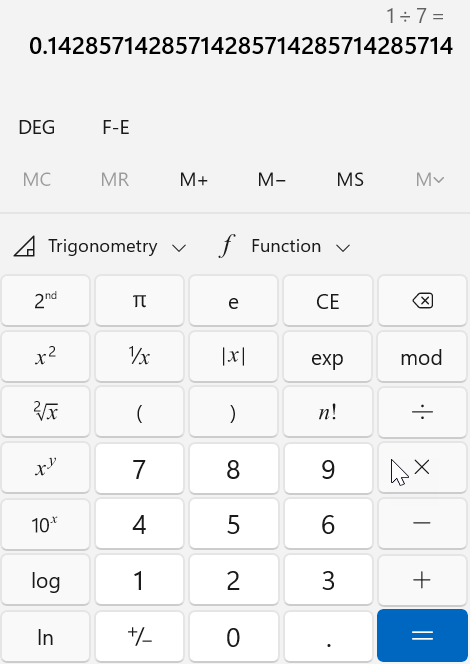
Figura 18
No começo, não parece que se repete. Entretanto, você vê que a série de números repete a sequência 142857.
Quando você se depara com problemas como esse, ajuda arredondar para o centésimo mais próximo. No exemplo acima, como o dois na posição dos milésimos indica um arredondamento para baixo, a resposta seria 0.14.
Lembre-se
Passos da divisão:
- Coloque o número que está sendo dividido (o dividendo) abaixo da caixa e o outro número (o divisor) à esquerda da caixa.
- Começando pela esquerda, determine quantas vezes o divisor pode caber no primeiro dígito do dividendo.
- Escreva esse número acima do dígito e subtraia o produto desse número e o divisor do dividendo.
- Repita os passos 2 e 3, indo para a direita.
- Se você chegar ao final do dividendo e o problema não estiver completo, adicione uma casa decimal ao final com zeros para que você possa descer números adicionais conforme necessário.
- Ao adicionar um decimal ao dividendo, um decimal também deve ser adicionado à resposta.
- Ao arredondar para o centésimo mais próximo, se o número na casa dos milésimos for cinco ou mais, arredonde para cima. Se o número for menor que cinco, arredonde para baixo.
Problemas Práticos
- \(77 ÷ 2 = ?\) (
Detalhes:
Comece dividindo em partes. Primeiro, divida 7 por 2.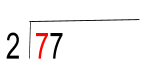
Coloque sua resposta acima da linha e diretamente acima do 7. A resposta será 3, porque 2 cabe em 7 cerca de 3 vezes.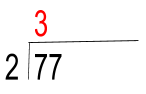
Coloque o resultado de \(2 \times 3\) abaixo do 7 e subtraia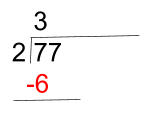
A diferença entre 7 e 6 é 1. Coloque a resposta diretamente abaixo do 6.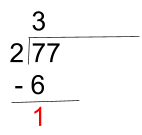
O próximo passo é descer o próximo número. Desça o segundo 7 e coloque-o ao lado do 1.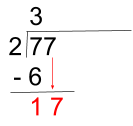
Divida 17 por 2. A resposta é cerca de 8.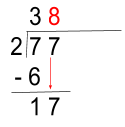
Coloque o resultado de \(8 \times 2\), 16, abaixo do 17 e subtraia.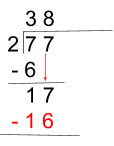
A diferença entre 17 e 16 é 1. Coloque o 1 abaixo do 6.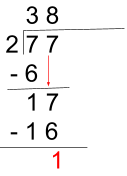
Neste ponto, há um número restante. Adicione um decimal e um zero depois do 77..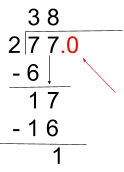
Continue trazendo o novo zero para baixo.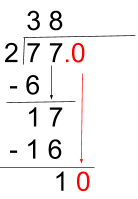
Divida 10 por 2 e coloque a resposta, 5, ao lado do 8 acima do novo 0 na solução.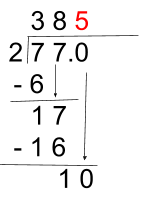
Coloque os resultados de \(2 \times 5\) abaixo do 10 e subtraia. A diferença entre 10 e 10 é zero. Quando você chega a 0, você para de dividir.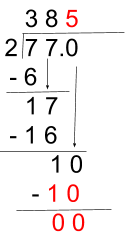
Coloque o ponto decimal entre 38 e 5. Observe que o ponto decimal na resposta é colocado diretamente acima do ponto decimal em 77.0.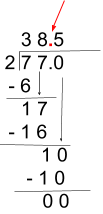
A resposta é 38.5. - \(339 ÷ 4 = ?\) (
Detalhes:
Comece dividindo 33 por 4..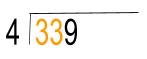
O 4 cabe no 33 cerca de 8 vezes.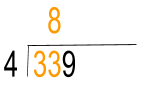
Coloque a resposta de \(8 \times 4\), 32, abaixo de 33 e subtraia.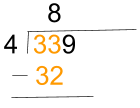
Há um resto de 1. Coloque-o abaixo da linha e traga o 9 para baixo.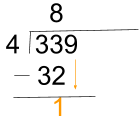
Divida 19 por 4.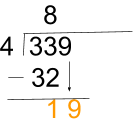
O quatro cabe no 19 cerca de 4 vezes porque \(4 \times 4 = 16\). Coloque o novo 4 ao lado do 8 na resposta.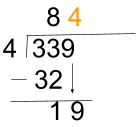
Coloque o produto de \(4 \times 4\), 16, abaixo do 19 e subtraia.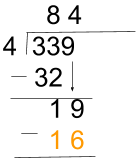
A diferença entre 19 e 16 é 3. Coloque o 3 abaixo da coluna mais à direita.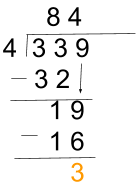
Em seguida, adicione um ponto decimal após o 9 no dividendo (339) e inclua dois zeros.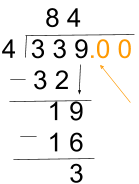
Continue o mesmo padrão. Traga o próximo número para baixo. Neste caso, o zero. Divida 30 por 4.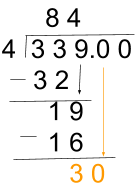
O 4 cabe no 30 cerca de 7 vezes.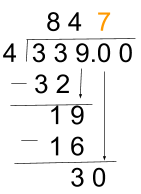
Coloque o produto de \(4 \times 7\), 28, abaixo do 30 e subtraia.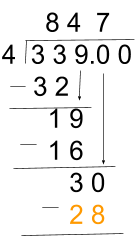
A diferença entre 30 e 28 é 2. Coloque o 2 abaixo da linha. Observe que você teve que fazer um reagrupamento para fazer essa subtração.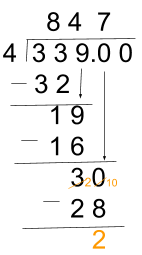
Continue trazendo o último 0 para baixo, ao lado do 2. Divida 20 por 4.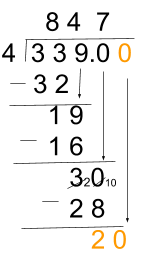
O número 4 cabe em 20 exatamente 5 vezes porque \(4 \times 5 = 20\). Subtraia para obter um zero.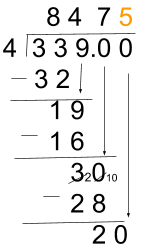
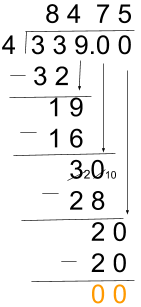
O último passo é colocar o ponto decimal na resposta. Coloque o ponto decimal entre 84 e 75, alinhado com o ponto decimal no dividendo: 339.00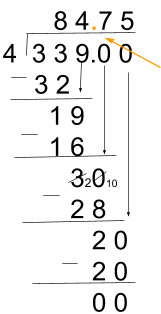
A resposta final: 84.75. - \(21 ÷ 8 = ?\) (
- \(37 ÷ 3 = ?\) (
- \(559 ÷ 6 = ?\) (
- \(258 ÷ 7 = ?\) (