Back
Divisão por um Decimal
> ... Matemática > Divisão e Porcentagem > Divisão por um Decimal

Introdução

Nesta lição, você aprenderá a dividir por um decimal. Antes, você trabalhou com o dividendo como um decimal, e agora trabalhará com o divisor como um decimal. A divisão por um decimal pode parecer difícil, mas, na verdade, há apenas um passo simples que você precisa seguir antes de poder dividir por um número decimal.

Formas de Mostrar a Divisão

O símbolo de divisão (÷) não é a única forma de mostrar a divisão. Como aprendemos anteriormente na lição sobre como usar o Excel como calculadora, a divisão também pode ser simbolizada por uma barra (/). Você também pode ver isso em algumas calculadoras. Este curso usará, frequentemente, o símbolo / para representar divisão.


Este vídeo ilustra o material da lição abaixo. Assistir ao vídeo é opcional.


Divisão por um Decimal

Quando o divisor (o número pelo qual você está dividindo) tiver um decimal, siga estes passos:

  1. Conte as casas decimais no divisor.
  2. Mova o decimal no dividendo de acordo com a quantidade de casas que você contou no divisor. Se o divisor não tiver um decimal, adicione uma casa decimal ao final do número e preencha-a com 0. Coloque o decimal da sua resposta diretamente acima da casa decimal que você contou no dividendo.
  3. Divida, ignorando os decimais.

Exemplo 1

\(12\div1.5\)

O dividendo é o valor original com o qual você começa, neste caso, 12. O divisor neste exemplo é um decimal: 1.5. Comece contando as casas decimais no divisor.

Neste exemplo, o decimal seria movido um espaço, transformando 1.5 em 15. Como você teve que mover o decimal uma casa no divisor, deve mover o decimal uma casa no dividendo também, transformando 12 em 120.

\begin{align*} 12&\div 1\underrightarrow{.5} &\color{navy}\small\text{Conte as casas decimais no divisor}\\\\ 12\underrightarrow{.0}&\div 15 &\color{navy}\small\text{Move the decimal in the dividend}\\\\ 120&\div 15 &\color{navy}\small\text{Divida}\end{align*}

A resposta é 8.

\(12\div 1.5\) lhe dará a mesma resposta que \(120\div15\). Por que isto funciona?

Exemplo 2

\(6\div2\)

A divisão \(6\div2\) é representada pelos seguintes quadrados.

The image shows 6 squares.

Figura 1

Se você dividir os seis quadrados em dois grupos, ou dois conjuntos, quantos haveria em cada conjunto?

The 6 squares are shown to be divided into two groups.

Figura 2

Cada conjunto tem três dentro dele porque \(6\div2=3\).

E se você multiplicar o dividendo e o divisor por dez? \(6\times10=60\) e \(2\times10=20\). Agora, em vez de \(6\div2\), você tem \(60\div20\). Qual é a resposta?

A divisão \(60\div20\) é representada por sessenta quadrados. Para dividi-los em vinte conjuntos diferentes, você precisa descobrir quantos haveria em cada conjunto.

The image shows how 60 divided by 20 is represented with sixty squares.

Figura 3

Observe que há 20 fileiras de quadrados. Para dividir por 20, você pode simplesmente selecionar cada linha, formando 20 conjuntos. Há 3 quadrados em cada conjunto, o que significa \(60\div20=3\).

The image shows 20 rows of squares. There are 3 squares in each set.

Figura 4

Isso demonstra que, desde que você multiplique o dividendo e o divisor pelo mesmo número, neste caso 10, a resposta ainda será a mesma.

Lembre-se do Exemplo 1: \(12\div1.5\). Você moveu ambos os números uma casa decimal, resultando em \(12

\begin{align*} \frac{12}{1.5} = \frac{12 \color{green}\times 10}{1.5 \color{green}\times 10} & = \frac{120}{15}\\ \end{align*}

Exemplo 3

\(8.52 \div 2.13\)

  1. Conte as casas decimais no divisor. Neste caso, há duas casas decimais.
  2. Conte o decimal no dividendo duas casas para a direita. Coloque o decimal da resposta diretamente acima de onde você parou de contar.

The image two decimal places in the divisor, and two decimal places to the right for the dividend, putting the decimal for the answer directly above where you stopped counting.

Figura 5

Divida como se não houvesse decimais.

The image shows that you should divided as if there are no decimals.

Figura 6

Assim, \(8.52 \div 2.13=4\)

Exemplo 4

\(43.875 \div 2.1\)

  1. Conte as casas decimais no divisor. Neste caso, há uma casa decimal.
  2. Conte o decimal no dividendo uma casa à direita e, em seguida, coloque o decimal da resposta diretamente acima de onde você parou de contar.

There is one decimal place for the divisor. There is one decimal place in the dividend where you should put the decimal for the answer directly above where you stopped counting.

Figura 7

Divida como se não houvesse decimais.

The number 2 is multiplied to 21 which equals to 42, then 42 is subtracted to 23 which equals to 1. The number 8 is then brought down next to number 1.

Figura 8

The number 20 is multiplied to 21 which equals to zero, zero is then subtracted from 18 which equals to 18. the number 7 is then brought down next to number 18.

Figura 9

The number 8 is multiplied to 21 which equals to 168, 168 is then subtracted from 187 which equals to 19. Number 5 is then brought down next to number 19.

Figura 10

Number 9 is multiplied to 21 which equals to 189, it is then subtracted from 195 which equals to 6.

Figura 11

Assim, a divisão \(438.75 \div 21\), arredondada para o centésimo mais próximo, dá 20.89.


Lembre-se

  • Ao fazer o algoritmo de divisão com um decimal no divisor:

    1. Conte as casas decimais no divisor.
    2. Mova o decimal no dividendo de acordo com a quantidade de casas que você contou no divisor. Mova o decimal para cima até sua resposta.
    3. Divida.


Problemas Práticos

Analise as seguintes expressões:
  1. \(54 \div 1.2 = \text{?}\) (
    Solução
    x
    Solução:
    45
    )
  2. \(69 \div 2.4 = \text{?}\) (
    Solução
    x
    Solução: 28.75
    Detalhes:
    Mova o decimal um espaço para a direita no divisor e no dividendo. (É a mesma coisa que multiplicar ambos os números por 10.)
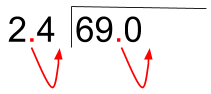
    The numbers two-point-four and sixty-nine-point-zero are written on the same imaginary horizontal line but they are separated by the division symbol. The division symbol is a short vertical line connected to a long horizontal line as though they are making the top left corner of a rectangle. The decimal points in each number are highlighted and there is a curved arrow below each pointing over to the right one digit.

    O divisor agora é um número inteiro positivo ou número natural, 24, e o dividendo é 690.
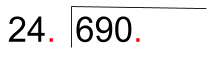
    This is the same as the previous image except the arrows are gone and the decimal points have moved. The numbers are now twenty four and six hundred ninety. They are still separated by the division symbol.

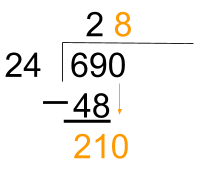
    Divida 69 por 24. A resposta é cerca de 2, já que \(2 \times 24\) é 48. Coloque o 48 abaixo do 69 e subtraia.
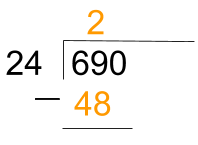
    This is the same as the previous image except there is a 2 above the division symbol and directly above the 9 in 690. There is also the number 48 written directly below the 6 and 9 respectively. There is a subtraction symbol written to the left of 48 and a horizontal line below the 48.

    A diferença entre 69 e 48 é 21. A seta mostra o próximo passo, que é trazer o zero para baixo.
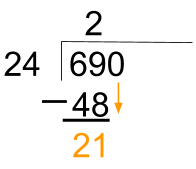
    This is the same as the previous image except there is the number 21 written directly below the new horizontal line. This is the solution to 69 subtract 48. There is also an arrow pointing downward from the zero in 690.

    Para continuar a divisão, divida 210 por 24.
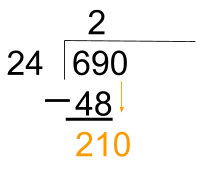
    This is the same as the previous image except there is an arrow pointing straight down from the 0 in 690 and a new 0 to the right of the 21 making it 210.

    A resposta é cerca de 8.

    This is the same as the previous image except there is an 8 to the right of the 2 in the solution area, directly above the division symbol. This new 8 is in the same imaginary column as the 0 in 690 but above it and the division symbol.

    \(8 \times 24\) é 192. Coloque 192 abaixo de 210 e subtraia.\(8 \times 24\) is 192. Place 192 below 210 and subtract.
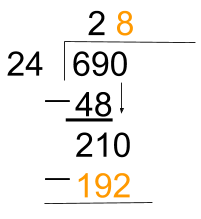
    This is the same as the previous images except at the bottom, under the number 210, is the number 192. They are stacked according to place value. There is a subtraction symbol to the left and a horizontal line stretching across the very bottom of the numbers.

    A diferença entre 210 e 192 é 18. Foi necessário fazer um reagrupamento para fazer a subtração.
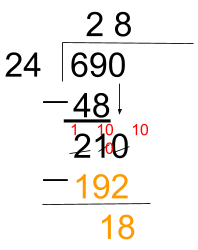
    This is the same as the previous image except now the subtraction of 210 minus 192 is taking place. To do this, the 1 in 210 was crossed out and replaced with a 0 and the 0 in 210 was replaced with 10. Below the ones column, under the solution line is now the number 8. In order to subtract the tens column, the 2 in the hundreds column is also crossed out and replaced by a 1, and the current 0 in the tens column is now a 10. Below the tens column in the solution is the number 1. The solution for this subtraction step is the 18 below the horizontal line at the bottom.

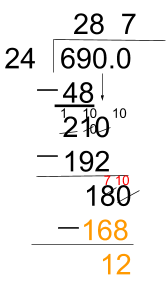
    Ainda há um resto, mas não há mais dígitos para descer no dividendo. Coloque um decimal e coloque um 0 na casa dos décimos do dividendo para ter um 0 que você pode descer e continuar o processo de divisão.
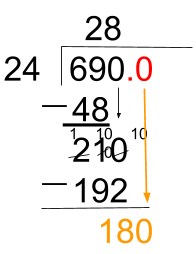
    This is the same as the previous image except now there is a point 0 to the right of the 690 in the original number under the division symbol. There is also an arrow pointing directly down from this new 0 to the right of the 18 from the previous step and a new 0 written there making it 180.

    180 dividido por 24 é aproximadamente 7. Coloque o 7 no topo, próximo ao 8, e deixe um espaço para o ponto decimal que será inserido no final.
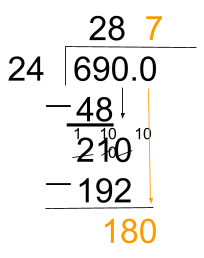
    This is the same as the previous images except there is a 7 written above the division symbol, directly above the new 0 to the far right of the number 690 point 0.

    \(24 × 7 = 168\)

    Coloque 168 abaixo de 180 e subtraia.
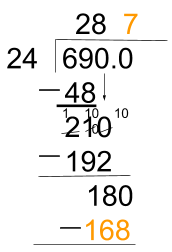
    This is the same as the previous image except there is now the number 168 directly under the 180 at the bottom of the problem. There is also a subtraction symbol to the left and a new horizontal line stretching under the 168.

    A diferença entre 180 e 168 é 12.
    This is the same as the previous image except that the 8 in 180 has been crossed out and replaced with a 7. The 0 in 180 has also changed to 10. Under the newest horizontal line, under the 10 subtract 8 is the number 2. Under the 7 subtract 6 is the number 1. This makes the newest number at the very bottom of our columns of numbers the number 12.

    Para continuar, coloque outro zero na casa dos centésimos do dividendo. O número agora ficará 690.00. Desça o novo zero.
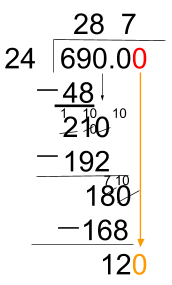
    This image is the same as the previous image another 0 has been added to the right side of the original number 690 point 0 making it 690 point zero zero. There is also an arrow pointing straight down from this new 0 and just to the right of the 12 from the previous step. There is a new 0 there making the bottom most number 120.

    Agora, divida 120 por 24.
    O 24 cabe no 120 exatamente 5 vezes. Coloque um 5 ao lado do 7.
    Coloque 120 abaixo do 120 e subtraia. A diferença é zero, ou seja, não há resto, então você sabe que deve parar o processo de divisão.
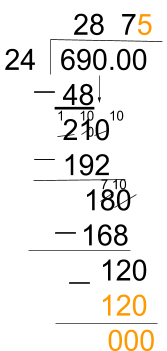
    This is the same as the previous image except there is now a 5 to the right of the 7 above the division symbol. There is also the number 120 written directly under the other 120 and a subtraction symbol, and a horizontal line. Below this new horizontal line are the numbers zero zero zero signifying that 120 minus 120 equals 0 for all the columns.

    A resposta ainda não está completa. Observe que há um espaço entre 28 e 75. Coloque o ponto decimal neste espaço. A resposta para este problema é 28.75. Há uma seta apontando do ponto decimal em 690.00 para 28.75 para indicar onde colocar o ponto decimal.
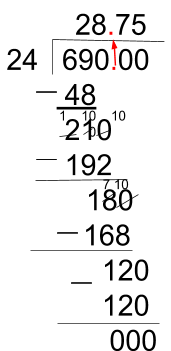

    This is the same as the previous image except there is now an arrow from the decimal point in 690 point zero zero pointing up to a new decimal point directly above it in the solution area between the 8 and the 7. This makes the final solution 28 point 75.

    Observação: É importante manter todos os números alinhados ordenadamente em suas colunas ao resolver problemas de divisão para manter o controle do ponto decimal e obter os dígitos corretos
    )
  3. \(8.4 \div 6.5 = \text{?}\) (Arredonde a resposta para o centésimo mais próximo.) (
    Solução em Vídeo
    x
    Solução: 1.29
    Detalhes:

    | Transcrição)
  4. \(24.7 \div 3.9 =\text{?}\) (Arredonde a resposta para o centésimo mais próximo.) (
    Solução em Vídeo
    x
    Solução: 6.33
    Detalhes:

    | Transcrição)
  5. \(62.5 \div 1.75 =\text{?}\) (Arredonde a resposta para o centésimo mais próximo.) (
    Solução
    x
    Solução:
    35.71
    )
  6. \(25 \div 4.35 = \text{?}\) (Arredonde a resposta para o centésimo mais próximo.) (
    Solução
    x
    Solução: 5.75
    Detalhes:
    Como o divisor no problema tem dígitos até o valor posicional dos centésimos, você precisa multiplicar o divisor e o dividendo por 100. Isto transformará o divisor em um número inteiro, mas não alterará a resposta final do problema de divisão.
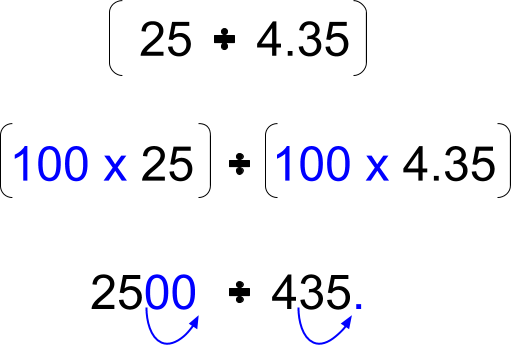
    There are three lines of equations. The top line is 25 divided by 4.35. The middle line is (100 times 25) divided by (100 times 4.35). The third line is 2500 divided by 435. On this third row, under the number 2500 is an arrow showing the decimal point for 25 moved two digits to the right and was filled in by two zeros. It also shows an arrow from the original location of the decimal point of 4.35, pointing two spaces to the right making it 435.

    Agora, você tem 2500 dividido por 435.
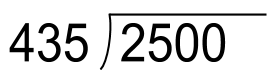
    The long division symbol of a long horizontal line and a short vertical line intersecting to create the upper left hand corner of a rectangle is in this picture. Under the horizontal line is the number 2500. To the right of the symbol is the number 435. They are separated by the vertical line of the symbol.

    O 435 não cabe no 2, nem no 25, no mesmo em 250.

    Você precisa chegar a 2500 antes de começar a criar conjuntos de 435.

    Ao lidar com números grandes, você precisa, às vezes, adivinhar e depois mudar seu palpite para encontrar os números corretos para a solução.

    Você está procurando um número que, quando multiplicado por 435, seja próximo de 2500, mas não maior que ele.


    Palpite nº 1: 7

    \(435 \times 7 = 3045\)

    Como 3045 é maior que 2500, 7 é muito grande. Você precisa adivinhar um número menor.

    Palpite nº 2: 6

    \(435 \times 6 = 2610\)

    Ainda é mais de 2500, mas está muito próximo. Provavelmente, você só precisa descer mais um número.

    Palpite nº 3: 5

    \(435 \times 5 = 2175\)

    Isso é menos de 2500, mas ainda está próximo.

    Coloque o 5 no loca da resposta acima do 0 na posição das unidades de 2500.
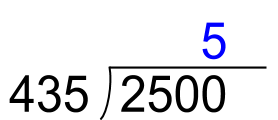

    This is the same as the previous image except there is now a 5 above the division symbol and directly over the rightmost 0 of the number 2500.

    Multiplique \(5 \times 435 = 2175\).

    Coloque 2175 abaixo de 2500 e subtraia.
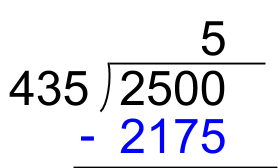
    This is the same as the previous image except there is now the number 2175 directly under the corresponding place value digits of the number 2500. There is also a subtraction symbol to the left and a horizontal line stretching below them.

    \(2500 - 2175 = 325\)

    É necessário fazer um reagrupamento para fazer essa subtração.
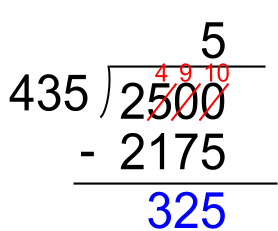
    This is the same as the previous image except now the 5 and two zeros of 2500 are all crossed out and replaced with 4, 9, and 10 respectively. Below the new horizontal line is the number 325. It is lined up so the 3 is under the hundreds column of the previous numbers, the 2 is under the tens column, and the 5 is under the ones column.

    Isto significa que você tem uma sobra ou um resto de 325. Esse número não é suficiente para formar um grupo de 435, então você coloca um ponto decimal e outro zero no dividendo e desce esse zero.
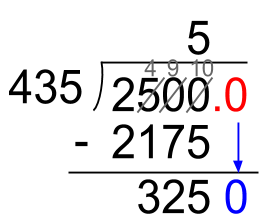
    This is the same as the previous image except there is now point 0 added to the right hand side of the original number 2500. There is also an arrow pointing directly down from this new 0 pointing to a new zero written to the right of the number 325 making the new number at the bottom of the rows 3250.

    Agora, encontre o número de vezes que 435 cabe em 3250. Novamente, use o método de adivinhação.

    Palpite nº 1: 7

    Você já usou este palpite antes e sabe que \(435 \times 7 = 3045\). É um número próximo de 3250, mas ainda menor.

    Coloque um 7 no local da resposta ao lado do 5 e acima do novo 0.
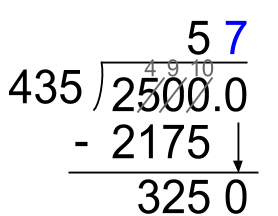
    This is the same as the previous image except there is now a 7 above the division symbol just to the right of the 5.

    Multiplique \(7 \times 435 = 3045\), coloque 3045 abaixo de 3250 e subtraia. Faça qualquer reagrupamento necessário.
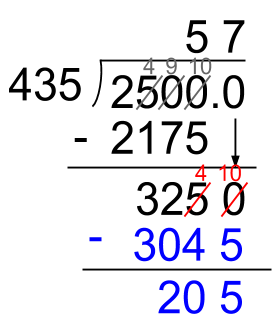
    This is the same as the previous image except now the number 3045 is positioned below the number 3250 according to place value. There is also a subtraction symbol to the left and a horizontal line below these numbers. The subtraction for this has taken place. The numbers 5 and 0 of 3250 were crossed out during the subtraction process and replaced with the numbers 4 and 10 respectively. The number 205 is now positioned according to place value, below the horizontal line, according to place value.

    Agora, você tem um resto de 205. Você precisa de outro 0 para continuar o processo de divisão. Coloque outro 0 na casa dos centésimos do dividendo e coloque-o próximo ao 205, resultando em 2050.
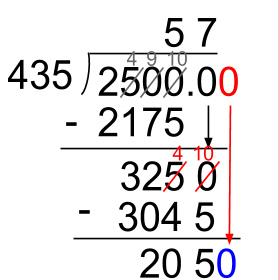
    This is the same as the previous image except now there is another 0 to the right of the decimal point making the original number under the division symbol 2500 point zero zero. There is also a line pointing straight down from this new 0 to a 0 at the end of our previous subtraction solution. This makes the number at the bottom of the image 2050.

    Desta vez, você adivinha que o 435 cabe 4 vezes no 2050.

    Coloque o 4 acima do novo 0 no dividendo e ao lado do 7.

    Multiplique \(4 \times 435 = 1740\). Coloque 1740 abaixo de 2050 e subtraia.
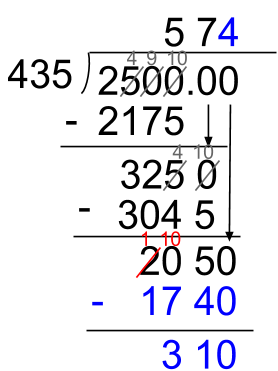
    This is the same as the previous image except now there is a 4 in the solution area above the division symbol, directly above the new 0 from the previous step. This makes the numbers in the current solution area, from left to right, 5 7 4. At the bottom, under the 2050, is the number 1740. There is a subtraction symbol to the left and a horizontal line below this new number. The 2 in the number 2050 has been crossed out and replaced by a 1 and the 0 in the hundreds column has been changed into a 10. Below the new horizontal line is the number 310.

    Você ainda tem um resto, então o processo continua.

    Desça outro 0. Adivinhe um múltiplo próximo de 435. Multiplique este palpite por 435. Subtraia.
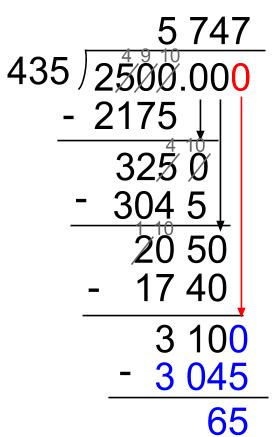

    This is the same as the previous image except there is a new 0 to the far right of the original number being divided making it 2500 point zero zero zero. There is a line pointing straight down from it to a new zero at the end of the previous subtraction solution at the bottom, making it 3100. A 7 is now to the far right of the solution area making the digits in the solution area above the division symbol 5 7 4 7. Back down at the bottom, below the 3100 is the number 3045. There is a subtraction symbol to the left of this and a horizontal line below it. Under this new horizontal line is the number 65.

    Novamente, você ainda tem um resto. Se você precisar continuar o problema de divisão, continue, mas, em algum momento, é geralmente suficiente parar e arredondar a resposta final.

    Neste problema, coloque o ponto decimal entre 5 e 7.

    Isto significa que a solução está próxima de 5.747…. As casas decimais depois do ponto decimal continuam além do que você resolveu.
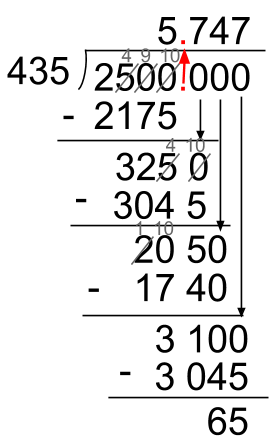
    This is the same as the previous image except there is now an arrow pointing up from the decimal place in the number 2500 point zero zero zero. It is pointing to a decimal place in the solution area between the 5 and the first 7 in the numbers 5 7 4 7. This makes the solution 5 point 7 4 7.

    Você encontrou dígitos suficientes na solução para arredondá-la para o centésimo mais próximo.

    5.747… arredondado para o centésimo mais próximo é 5.75.

    A solução final é aproximadamente: 5.75.
    )