

Introdução
Nesta lição, você aprenderá a estrutura básica da fatoração prima. Um número primo só pode ser dividido por um e por ele mesmo.
Esses vídeos ilustram o material da lição abaixo. Assistir aos vídeos é opcional.
Identificar Números Primos
Aprender a encontrar a fatoração prima de um número é importante quando você começa a aprender sobre frações. Isso é importante principalmente para reduzir frações. Veja aqui algumas palavras de vocabulário que te ajudarão nesta lição:
- Fator: Os números em uma operação de multiplicação. (Por exemplo: Em \(3\times4=12\), 3 e 4 são fatores de 12.)
- Produto: A solução da multiplicação. (Por exemplo: Em \(3\times4=12\), 12 é o produto.)
- Número Primo: Qualquer número em que os únicos fatores são 1 e o próprio número (por exemplo: O 11 é um número primo. Não existe outro número além do 1 e 11 pelo qual você possa dividir o 11 que lhe dará um número inteiro positivo ou número natural).
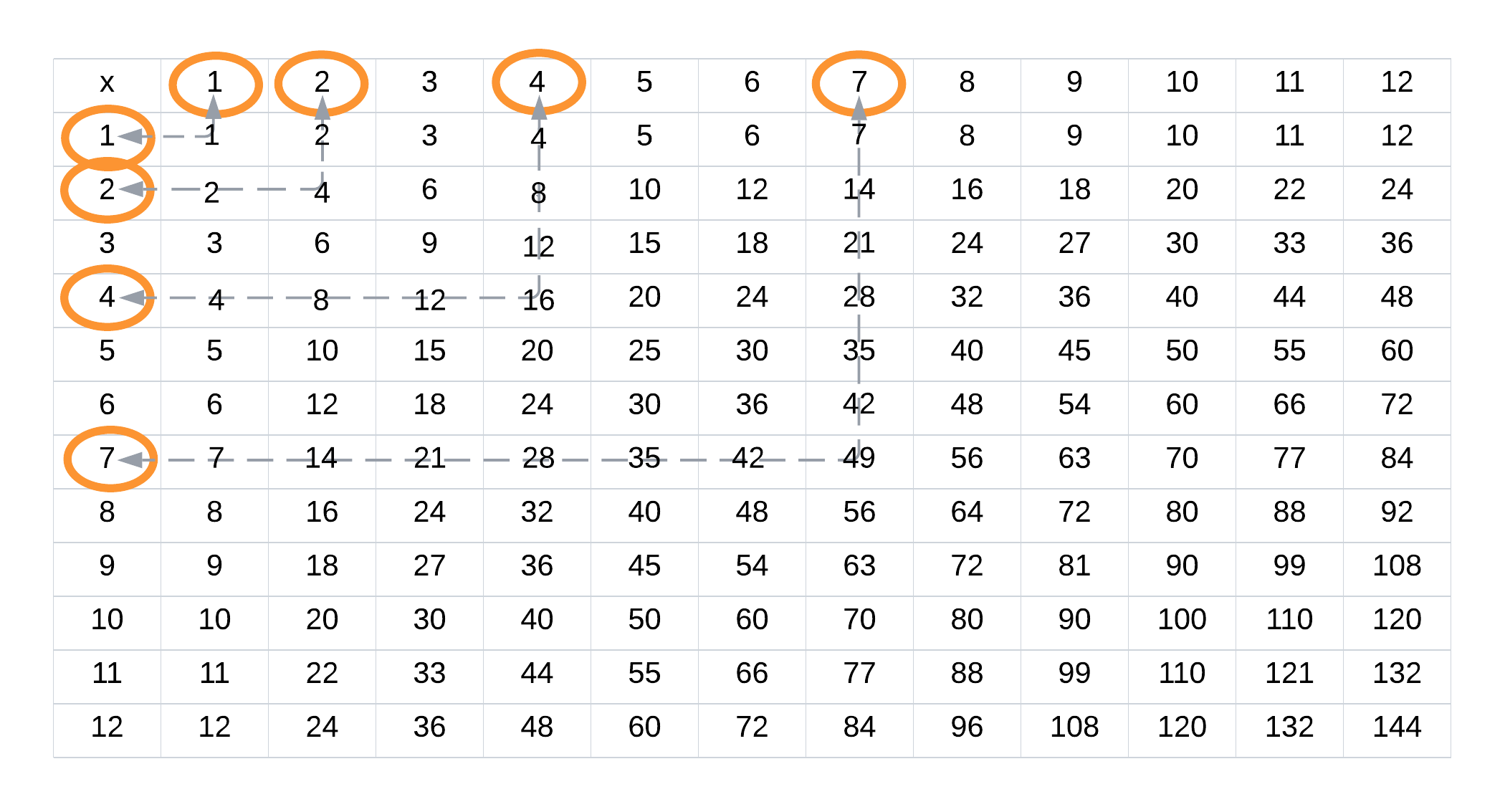
Figura 1
Usando a tabela de multiplicação acima, considere os seguintes números e aprenda como determinar se um número é primo:
- O um não é considerado primo; é simplesmente o número um. Há razões para isso, que você não precisa aprender agora. Saiba apenas que o número um não é considerado um número primo.
- Dois é \(1\times2\) e também é \(2\times1\), mas essas são as únicas ocasiões em que você vê o número dois na tabela de multiplicação. Então, dois é apenas o produto de um e ele mesmo, o que o torna um número primo.
Observação: O número dois é o único número par que é primo; todos os outros são números ímpares. Entretanto, nem todo número ímpar é primo.
- O quatro é múltiplo de \(1\times4\), \(4\times1\) e \(2\times2\). O quatro não pode ser um número primo porque tem outros fatores: 1, 2, 4. Lembre-se, fatores são números que, quando multiplicados, criam um produto.
- Sete é o produto de \(1\times7\) e \(7\times1\). Mas, novamente, esses são os únicos dois casos em que o três aparece no gráfico, o que indica que três é um número primo.
Quais são outros números primos no gráfico? A Figura 2 destaca os números primos em amarelo até o número 139.
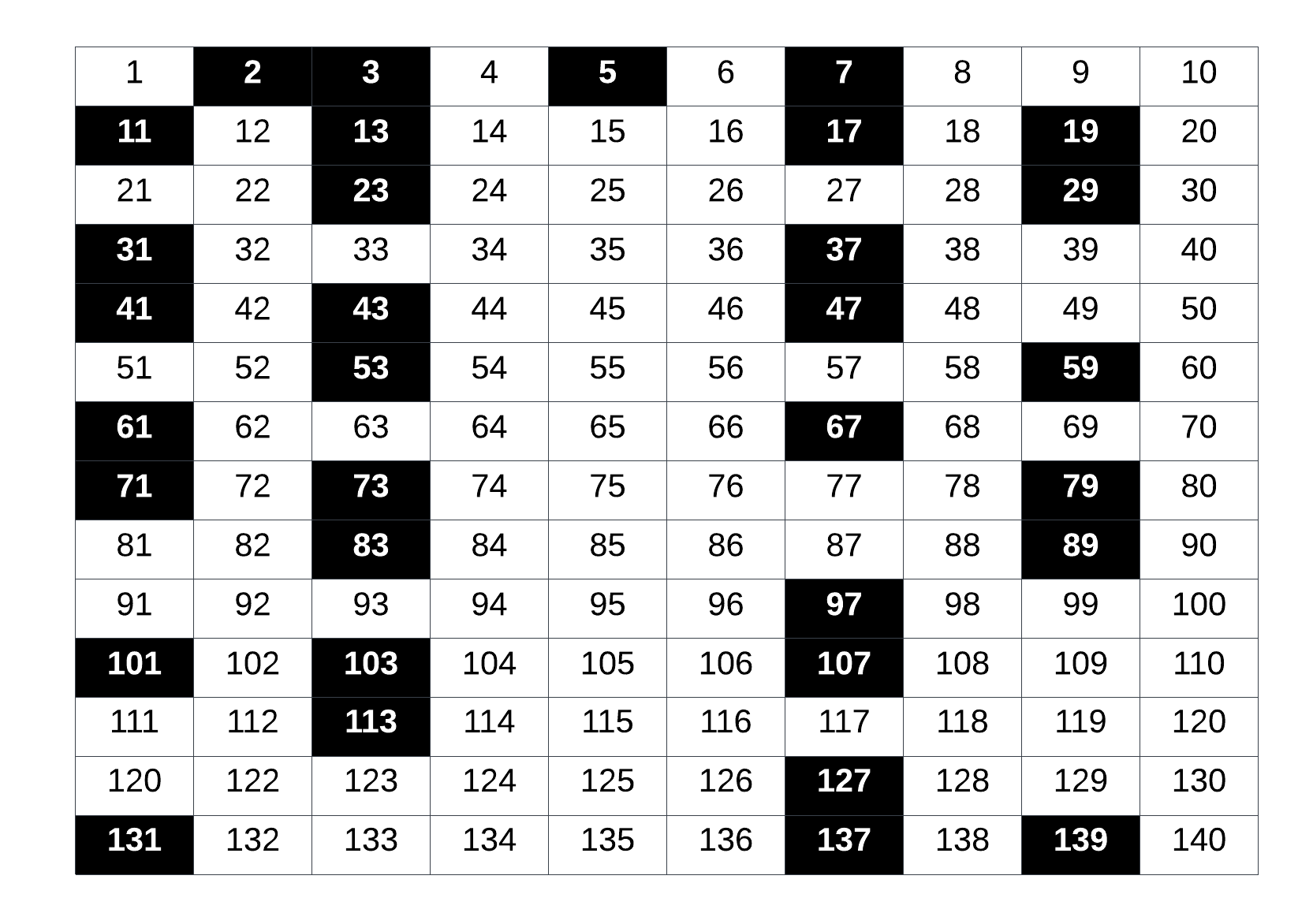
Figura 2
Fatoração Prima
Os menores números nos quais você pode decompor um número são os números primos porque um número primo não pode ser decomposto em mais nada.
Exemplo 1
O 14 não é primo porque é o mesmo que \(2\times7\).
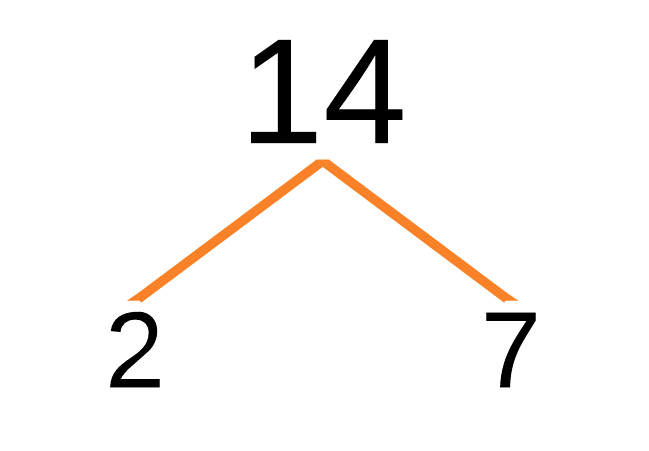
Figura 3
A fatoração é \(2\times7\). Para fatorar um número, divida-o listando os fatores abaixo e criando um formato semelhante a uma árvore. Depois, avalie os fatores. Como os fatores 2 e 7 são primos, esse é o máximo que você pode fatorar 14. Portanto, 2 e 7 são fatores primos de 14.
Exemplo 2
Há muitas maneiras de obter 40, como \(8\times5=40\) e \(4\times10=40\). Isso significa que 40 pode ser fatorado de várias maneiras. Primeiro, tente usar os fatores 4 e 10.
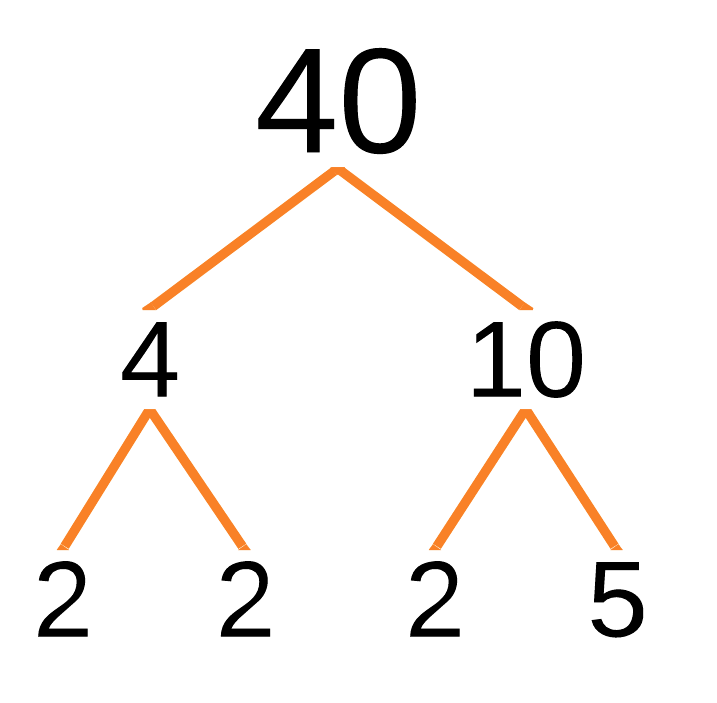
Figura 4
O 4 não é um número primo, então você pode dividi-lo ainda mais. \(2\times2=4\), e 2 é primo, então é até aqui que você consegue chegar com o 4. O outro fator, 10, também não é primo. O 10 pode ser dividido em \(2\times5=10\), e 2 e 5 são primos.
A fatoração prima de 40 é \(2\times2\times2\times5\), ou você pode até mesmo escrever isso em uma notação exponencial como \(2^{3}\times5\). Ambos os formatos transmitem a resposta correta.
Agora, tente usar os fatores de 8 e 5 porque o 40 também pode ser dividido em \(8\times5\). A figura abaixo mostra essa fatoração.
Figura 5
Ao fatorar dessa forma, ainda temos \(2\times2\times2\times5\) como fatores primos de 40.
Exemplo 3
Qual é a fatoração prima de 19? Observe o gráfico e veja quais múltiplos compõem 19 antes de olhar para a Figura 6 abaixo.

Figura 6
Como o 19 não tem múltiplos além de 1 e 19, é aí que a fatoração termina. O 19 é um número primo.
Exemplo 4
O 210 tem um fator de 2 porque é um número par. \(2\times105\). O 105 tem um fator primo de 5 porque termina com 5: \(5\times21\). O 21 tem dois fatores primos: 3 e 7. Portanto, a fatoração prima de 210 é \(2\times5\times3\times7\).

Figura 7
Depois de saber o que são números primos, você aprende que cada número é composto de números primos menores. A ação de decompor um número em números primos que o compõem é chamada de fatoração prima. Todo número tem uma fatoração prima. No caso dos números primos, seus únicos fatores são eles mesmos e 1.
Lembre-se
- Números primos são números que só podem ser divididos por um e por eles mesmos.
- Os números primos são compostos de números ímpares, exceto o número dois. Mas lembre-se de que nem todo número ímpar é primo.
- Fatores são números que criam um produto.
- Fatorar o número significa chegar até os números primos. Você pode fazer isso com qualquer número que receber, até mesmo um número primo, embora não consiga ir muito longe com ele.
Problemas Práticos
- 21 (
Detalhes: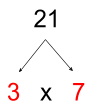
\(3 \times 7 = 21\); e 3 e 7 são fatores primos. A fatoração prima do número 21 é 3 e 7. - 13 (
Detalhes: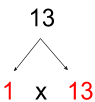
A definição de um número primo é qualquer número cujos únicos fatores são 1 e ele mesmo.
Os únicos fatores de 13 são 1 e ele mesmo, 13. A fatoração prima de 13 é apenas 13. - 30 (
- 12 (
Detalhes:
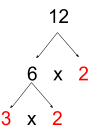
Primeiro, encontre os fatores de 12. Existem algumas maneiras de fatorar 12. Ele pode ser fatorado como \(4 \times 3\) ou \(6 \times 2\)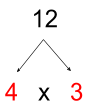
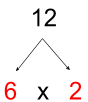
Os números 3 e 2 são primos, mas 4 e 6 não.
Encontre os fatores de 4 ou 6. Observe como a fatoração prima de 12 é \(2 \times 2 \times 3\), independentemente de os fatores iniciais serem \(4 \times 3\) ou \(6 \times 2\). A fatoração prima é a mesma.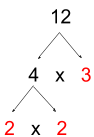
- 54 (
Detalhes: O 54 é um número par, então você sabe que ele é divisível por 2.
\(2 \times 27 = 54\)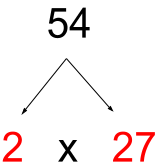
O número 2 é primo, mas 27 não é, então você deve encontrar os fatores de 27.
O 27 é divisível por 3:
\(3 \times 9 = 27\)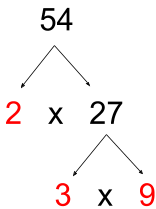
O número 3 é um número primo, mas 9 não é primo, então você deve encontrar os fatores de 9.
O 9 também é divisível por 3:
\(3 \times 3 = 9\)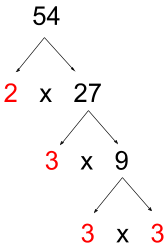
O número 3 é um número primo, então, na verdade, há mais dois 3 nesta fatoração prima.
Agora, olhe para trás e encontre todos os números primos na fatoração de 54.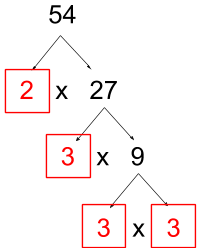
\(54 = 2 \times 3 \times 3 \times 3\) - 250 (